Publishing the ORA Polycrisis Directory
In 2023 we mapped over 40 organisations working on global polycrisis response, with a focus on the Global South. We are now publishing that directory.
Many directories of organisations working on civilisational change and societal transformation share a common bias: they surface what’s already visible in English-language, Northern/Western networks. Organisations based in or primarily oriented toward the Global South — often working on the intersecting systemic crises that don’t resolve into a single clean problem frame — are less well represented.
The ORA mapping was an attempt to address that.
In 2023, as part of the Omega Resilience Awards (ORA), we mapped over 40 organisations working on global polycrisis response, with a deliberate focus on actors underrepresented in mainstream ecosystem surveys. We are now publishing that directory: ecosystem.secondrenaissance.net/ora/directory/
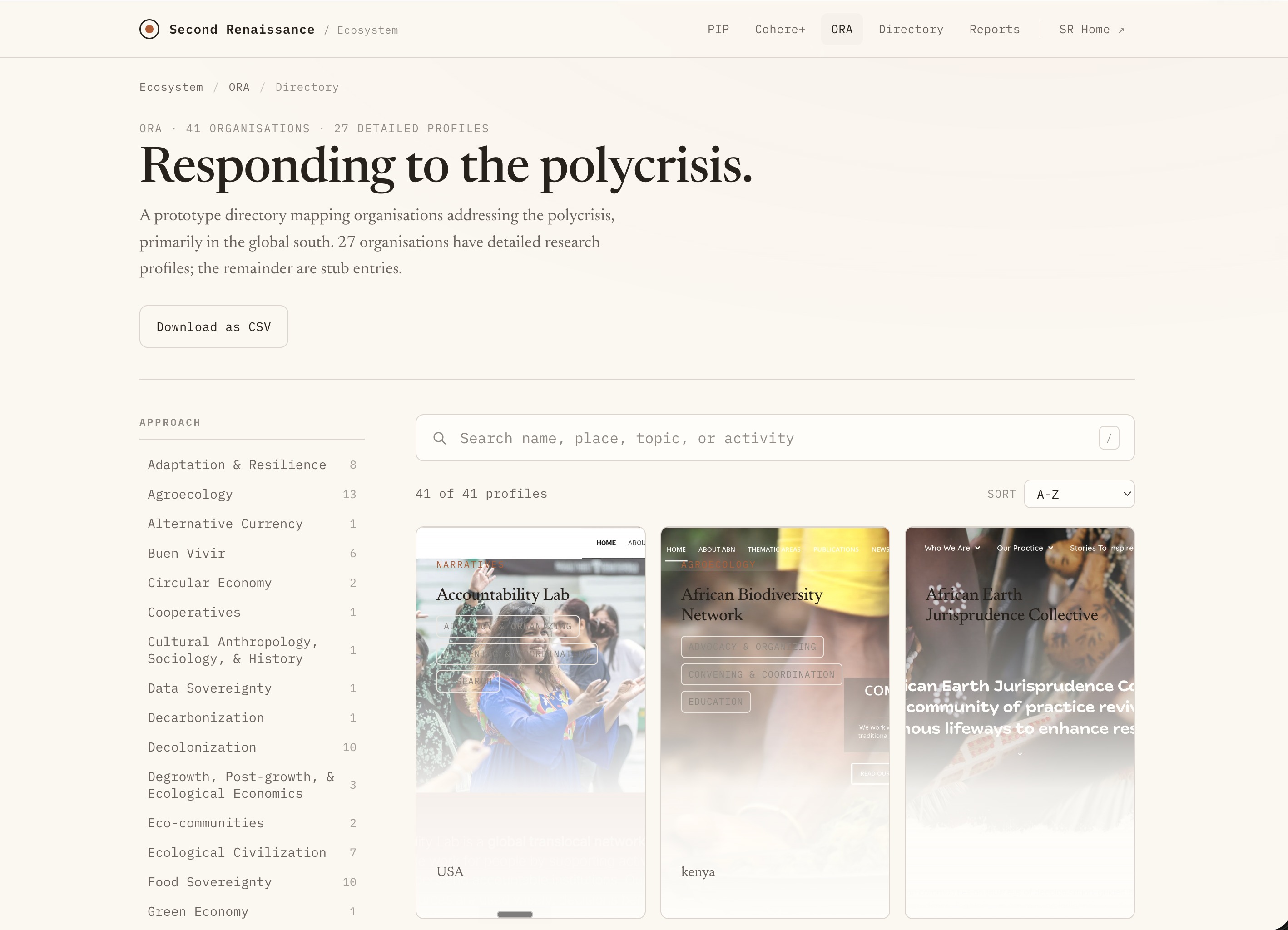
What’s in it
Over 40 organisations across Africa, Latin America, South and Southeast Asia, and beyond. 27 have detailed profiles including full qualitative assessments of how each organisation approaches systemic change — what their theory of change is, how they integrate different dimensions of transformation, what they actually do on the ground. The remaining entries are published as stubs — enough to identify and locate them — with full profiles to follow.
Each profile includes country, region, scale of operation, activity types, thematic focus areas, and (for detailed profiles) a full assessment against the PIP framework dimensions: Paradigmatic, Integrated, and Pragmatic approaches to change.
The raw data is also available as a CSV download if you want to work with it directly.
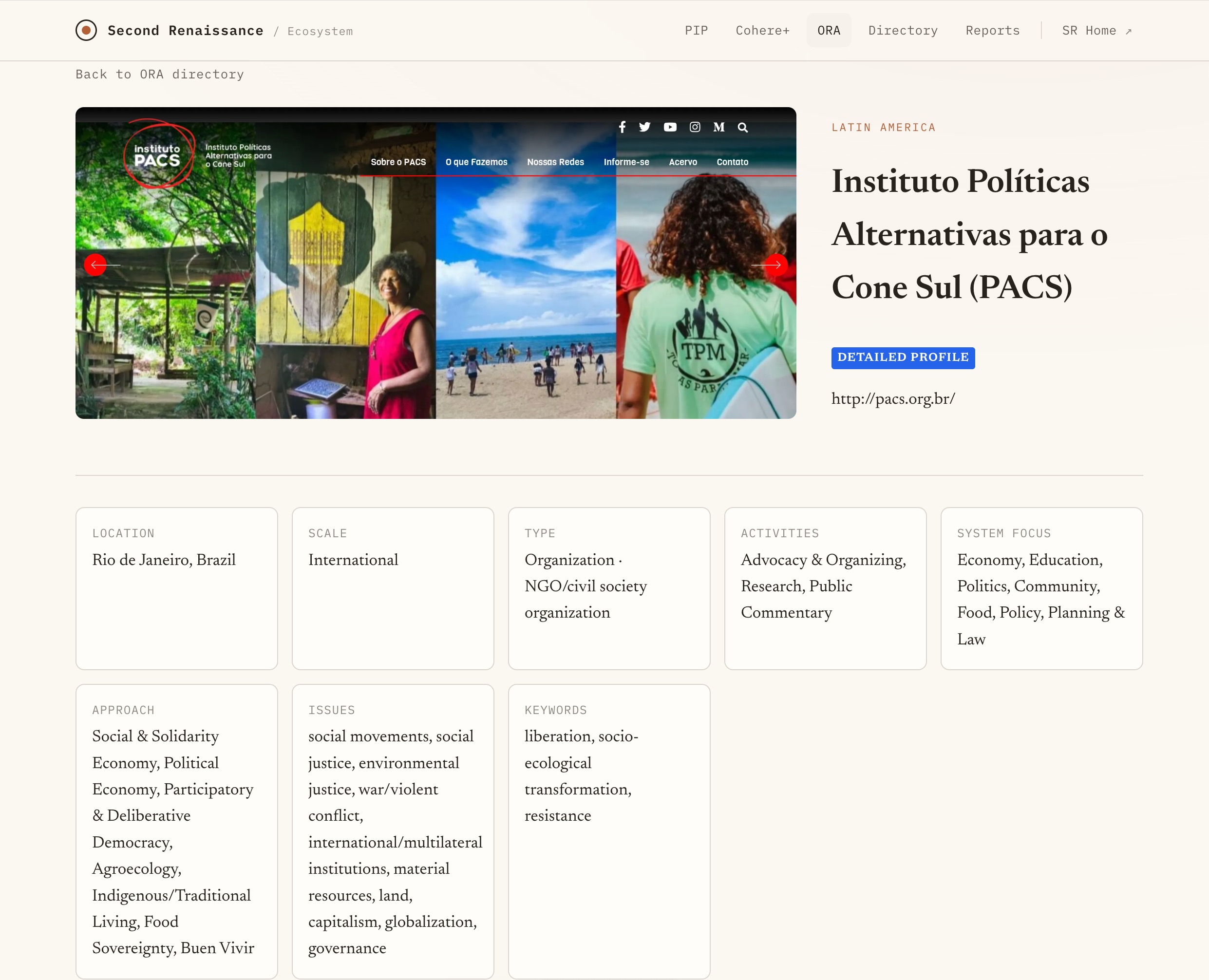
Why directories like this matter
Navigating the polycrisis response landscape without a map is genuinely difficult. Who is working on what, where, and with what theory of change? Which organisations are taking a paradigmatic approach — working on worldviews and inner dimensions — versus pragmatic responses? Mapping makes that landscape legible and helps researchers, funders, and practitioners find each other. For a deeper take on the value of ecosystem mapping, see Mapping for Emergence on the Life Itself blog — or read the full ORA report for the analytical framing behind this particular mapping.
If you work in this space, there’s a good chance you’ll find organisations here you haven’t encountered before.
Part of a larger consolidation
The ORA directory is one of three mappings now consolidated at ecosystem.secondrenaissance.net — alongside the PIP mapping (~150 organisations) and the Cohere+ directory (~300 organisations). Read more about the full consolidation.
Maintained by Life Itself as part of the Second Renaissance project. Profile data is in plain markdown — contributions welcome.